Sunday, October 27, 2013

learning through mistake

Math Errors - Learn From Them


"The most powerful learning experiences often result from making mistakes". I usually address my students with the above phrase after handing out marked papers, tests and exams. I then provide time for my students to carefully analyze their errors. I also ask them to keep a running record/journal of the patterns of their errors. Understanding how and where you go wrong will lead to enhanced learning and improved grades - a habit often developed by strong math students. It's not unlike me to develop my next test based on a variety of student errors!
How often have you looked over your marked paper and analyzed your errors? When doing so, how many times have you almost immediately realized exactly where you went wrong and wished that if only you had caught that error prior to submitting your paper to your instructor? Or, if not, how often have you looked closely to see where you went wrong and worked on the problem for the correct solution only to have one of those 'A Ha' moments? 'A Ha' moments or the sudden enlightening moment resulting from the newly discovered understanding of the misconceived error usually means a breakthrough in learning, which often means that you'll rarely repeat that error again.
Instructors of mathematics often look for those moments when they are teaching new concepts in mathematics; those moments result in success. Success from previous errors isn't usually due to the memorization of a rule or pattern or formula, rather, it stems from a deeper understanding of 'why' instead of 'how' the problem was resolved. When we understand the 'whys' behind a mathematical concept rather than the 'hows', we often have a better and deeper understanding of the specific concept.
Symptoms & Underlying Causes of Errors
When reviewing the errors on your papers, it's crucial that you understand the nature of the errors and why you made it (them). I've listed a few things to look for:
  • Mechanical errors (transposed number, sloppy mental math, hurried approach, forgotten step, lack of review)
  • Application errors (misunderstanding of one or more of the required step(s)
  • Knowledge based errors (lack of knowledge of the concept, unfamiliar with terminology)
  • Order of Operations (often stems from rote learning as opposed to having a true understanding)
  • Incomplete (practice, practice and practice, this leads to having the knowledge more readily available)
Success is Failure Inside Out!
Think like a mathematician and learn from your previous mistakes. In order to do so, I would suggest that you keep a record or journal of the patterns of errors. Mathematics requires a lot of practice, review the concepts that caused you grief from previous tests. Keep all of your marked test papers, this will assist you to prepare for ongoing summative tests. Diagnose problems immediately! When you are struggling with a specific concept, don't wait to get assistance (that's like going to the doctor three days after breaking your arm) get immediate help when you need it, if your tutor or instructor isn't available - take the initiative and go online, post to forums or look for interactive tutorials to guide you through.
Remember, problems can be your friends!

Thursday, October 24, 2013

A tragic stiry friends read it

Short Stories - Chainful Aspects
Chainful Aspects
 
It has been a long time, a very long one, almost about twenty days since he had left his house, his home, the place that belonged to his family. Since the past four months, there was chaos at home everywhere, in the living room, kitchen, bedroom, bathroom, toilet, passage, along with two balconies, each of which had individual stories, with a life of its own.

He is now in his early thirties, and trying hard to live amongst his own family members, sacrificing most of the things, but fighting for his own bit of space for freedom and privacy. His immersed nature in what the rest of the people would say as weird and having no sense in what is mentioned but he has a mind of his own, wherein he believes a life complete with all the incredible and marvellous things, which are expected from humans into their being of existence.

It has been an enormous span of time since the dawn of universe, its elements and their characteristics, all its entities have appeared, those which might have transformed into different forms, while a few of them destroyed. Such behaviour has been unknown to humanity, due to the dependence on proofs, deducted through science, a simple art of theory, and their proved implementations.

Very few people might believe imagination as a term used for generating ideas, or that it leads to various other beliefs, but it has been a major factor, which has made the life of humans to live in a sense of scope. Humans get ideas based on their experiences, based on either something that has occurred in their past or when something is implied within their minds. Even though there is no limit for imagination, humans would never agree to the fact that limitations are still in effect over what is being termed as imagination. He terms it as a mental progress, based upon the psychology of humankind’s current behaviour, nature of growth and development, natural environment, surroundings and various innumerable factors on which it depends on.

Nothing could explain, including the cumulative minds of the most intelligent people on Earth that they are only capable of thinking and imagining a microscopic fraction of what appears through all the eyes combined on this planet.

Life as known to him is full of fragrances and its essence and there are limitless possibilities to this purpose of living. However, some do believe that there is not as well. Some people live only for the sake of satisfying their own wishes, while others try to satisfy wishes of others. Nevertheless, there are those who also try to understand why there is a purpose in life after all. Moreover, if there is none, what makes it possible for them to decide and judge on what they live for? If the opposite is true, then it comes to why and to what extent does, the purpose becomes meaningful.

Most of the humans live their life as what they believe as normal lives. They believe in following the footsteps of those that are tried and tested is the safest, most secured and most successful way to live a life. It may be true that you might think in a different way, of course, why not. He believes in the existence of people who enact, behave or perform by living their lives. Some things are best forgotten when people are fixed with their ideas, thoughts and decisions. These possibly are three different types of people working on the mentioned things. Most common of them are those who listen to others and try to make the best of what is either decided or suggested. Certain numbers of people believe in only what they feel is correct. A select few tend to drive the vast majority of people who are utilised and absorbed into a cause.

He believes that Now is of the utmost importance, instead of the events occurred during the past. An individual’s behaviour is always different on any given two days, hours, minutes or seconds. However, it recreates, or rather executes in a repetitive fashion. A person may display a similar behaviour, but he is never the same individual at two separate times. Every day, a new and distinct energy form is created, transformed and destroyed. Although people only think that a day on planet Earth lasts for approximately twenty four hours, a day in the life of an individual could last anywhere between a single heartbeat to an everlasting immortality.

With the scope of a week imprinted within the minds of individuals living in cities and metropolitan areas, most of them think about their daily lives, their life in work, family, tensions, happenings around the world, business, society and other common matters. For the weekend, it is a bit different to some extent. There is no end to any of these. It is insignificant for such issues to advance towards future generations. This world lives on lies at its best. Its existence is at all places, no matter where we go, whatever we do. There need be only a few things performed for all of this to become history. On completion of that phase, that part of history needs a removal from not only humankind, but from the rest of the creatures as well. It would be a new beginning for all of them. They would not even know what happened.

With all these ideas in mind, he closed his eyes for a moment to think less and feel free. It was almost a sacred moment for him. Ah, it would all be over soon, was all that would bright up his mind.

After about a minute, he opened his eyes. There was nothing more to see anymore. The worst of everything was over by now. It must have been about five in the morning, but he did not know whether it was true or not. He only knew that it was going to be over. Everything was only a sleep away. It would be a start of a new beginning. A completely new life, without any expectations laid out with nothing to kill, live, survive, sacrifice, love, hate and all the other various infinite factors.

At that moment, he finally slept with no knowledge of anything about when he fell asleep and what occurred thereafter.

tragic story


There lived a sage in days of yore,
And he a handsome pigtail wore;
But wondered much and sorrowed more,
Because it hung behind him.

He mused upon this curious case,
And swore he'd change the pigtail's place,
And have it hanging at his face,
Not dangling there behind him.

Says he, "The mystery I've found -
Says he, "The mystery I've found!
I'll turn me round," - he turned him round;
But still it hung behind him.

Then round and round, and out and in,
All day the puzzled sage did spin;
In vain - it mattered not a pin -
The pigtail hung behind him.

And right and left and round about,
And up and down and in and out
He turned; but still the pigtail stout
Hung steadily behind him.

And though his efforts never slack,
And though he twist and twirl, and tack,
Alas!  Still faithful to his back,
The pigtail hangs behind him.
© William Makepeace Thackeray.

8 Reasons Why Reading is So Important

Reasons Why Reading is Important Article
Why is Reading so important?
Everyone knows reading is important, but have you ever asked yourself why is it so important? Here I list out 8 reasons why reading is important. Hope you can really find out the reason why reading is so important for you, so you got a brand new will to explore the world of reading.

1. Explore Yourself to New Thing

Through reading, you explore yourself to new thing, to new information, new ways to solve a problem, new way to achieve one thing. Who knows you might find your new hobbies within it? Who knows you might actually explore to one thing you really like and thus it become your career and success in the future? Exploration starts from reading and understanding.

2. Self Improvement

Reading does help you form a better you, isn’t it?  Through reading, you understand the world more; through reading you get to understand more on a topic that interest you, for example: How to build self confidence, how to make a better planning before action; how to memorize things better and more. All these self development start from the reading; through reading, you structure the path towards a better understanding and better actions to take in the future.

Books are the quietest and most constant of friends; they are the most accessible and wisest of counselors, and the most patient of teachers.  -Charles W. Elio-

3. Improve Understanding

The more you read, the more you understand one thing, the A to Z of a thing. Let me give an example here: reading allows you understand about crocodiles and its habits that you need to beware of places it usually appear, in the purpose of stay away from being harmed or bitten by it. Or perhaps you can try by real life experience, in approaching the crocodile, to see what happen. It does help you find out the truth of something right? Reading also increases the understanding of the rules of life, in order for you to adapt, adopt and accommodate into the society better. To play well in a game, you first need to understand the rules well enough.

4. Preparation to Action

Before you take action on anything, where do you seek for help and guidance? Reading is essential way which can help you out. In today’s world, getting reviews and feedback from other people is a big impact on what your next decision, the pros and cons of one thing. Read about how to cook a meal; how to play chess; which place is nice for the holiday family trip; read the menu before ordering food, read the manual before using a new gadget. These all can help you become more prepared before really get into it.
Read > Learn > Do > Achieve

Reading is a starting step of many things, which build a more solid stairs for you to climb up achieving something big out there.

5. Gain Experience from Other People

When you are reading, you are actually gaining the knowledge and experience of someone. It can faster up your success towards one thing, as you don’t need to repeat the same mistake while focus on the right path in achieving one thing. It’s like a mountain of gems for you to discover in books, of people’s success, failures and advices. Life is too short for you to keep repeating the mistakes that had been done by other people in the past, in order for you to reach the results that someone might already reached. There are four thousand plus billionaire and 12 million millionaires today. To become one of them, the first thing is to learn and get to know their past, what they did in the past that makes them where they are today. Reading is a great path to get to know them, and learn from these great people.

The art of reading is in great part that of acquiring a better understanding of life from one’s encounter with it in a book.  | André Maurois

6. Tools of Communicating

It is the most important tool of communicating, through reading, you communicate, through reading, you understand more, and thus you can communicate better with people. As if a person that know nothing, he hasn’t had anything to share, and he probably don’t even understand what people are sharing. Through reading, you build a more solid bridge of communication. It is one of the most important tools we use every day to connect with each other. Whereas if you don’t read, you can’t even connect with the world and what people are talking about out there, including understanding what this article is all about. Reading connects you with the world.

7. Connecting Your Brain

When reading, you’re in full silence, where reading connects directly to your brain. In silence, you seek for more; in silence, your brain is clear and focuses, thus you learn and grow, and therefore you feel and see from the point of view of the author, about everything in life. Hence you shape a better self.

Because silence exists with total abandon, it is fearless. Because silence is fearless, it holds the power that can break through any barrier. | On Silence

8. Boost Imagination and Creativity

Reading exposes you to a world of imagination, showing you nothing is impossible in this world. By reading, you are exploring a different angle to see a thing you’ve known, on how different action leads to different results. Books are beyond imagination, it’s like a huge spider web, where you keep linking to more and more, to things you knew, and things you just learn, structuring a new solution and answers.
So in your opinion, why is reading so important to you?


The graphic below illustrates the interdependence of vocabulary, reading ability and academic success.
icon


love and compassion part 2

Love and Compassion
The sacred energy of love and compassion, the Great Heart of the World, embraces us all, without condition, unifying all of life, unifying the whole creation within the warm spirit of kindness, appreciation and concern. With good fortune, we may meet people in whom this unfettered love shines strongly, allowing all around to bask in its light. The great saints and bodhisattvas, utterly emptied of themselves, transmit such love and compassion. In some instances of communal worship, the substance of this boundless ocean of love may envelop the whole assembly. It may enter a true marriage and may inform the bonds between parents and children. Whenever we look into another person’s eyes and recognize the sameness, that that person and I are the same, not really separate, this is love.
Despite appearances to the contrary, Divine love and compassion suffuse every corner of the world, even our own. Divine love stands before the awesome contradictions in our lives: our God-given freedom that offers the promise of profound joy as well as the suffering attendant on living. The Divine heart of compassion celebrates the beauty of the freedom within each person, a celebration made bittersweet by the price of freedom: inevitable suffering.
When we hear of or see another person’s misfortune, and we feel the pang of their suffering, and are moved to extend the help that lies within our power, this is compassion. For this we need strength, because suffering lies all around us. The daily news’ litany of catastrophes and evil deeds, large and small, could devastate us, were we awake to the whole of it and lacked the strength to bear it. But awakening through spiritual practice brings its own strength. And the suffering we see is more than balanced by the joy that flows to us along with love, protecting the compassionate from being overwhelmed by the force of suffering.
Universal love lies far beyond its pale imitation in the lower energies, where emotional attachment turns from “love” to hate, jealousy, or despair. Nevertheless, the world is so constructed that it remains within our possibilities to participate in love knowingly. But that can only happen to the degree we empty ourselves of ourselves.
Self-referential motives, self-centeredness, attachment, expectation of something in return, grasping, setting of conditions, partial-heartedness - none of these have any place in love and, in practice, completely block the action of love. Placing ourselves first and at the center forecloses the possibility of love. Yet moments do come even to us, perhaps with our family or our pets or unexpectedly with a stranger, when we are briefly free of egocentric attachment and the true heart of objective love opens within us. In unguarded moments, our natural response to people is friendship, one of the faces of love. To be able to love is a goal lofty and worthy enough to sustain our long journey along the path, drawing us ever forward.
Our common mother, the Earth, also loves, loves each one of us and all life in her biosphere. Like a self-centered and petulant child, we only too rarely return this love. And like a child, we so take for granted the love of our mother Earth, that we do not even recognize it. Yet her love is there for us individually, in nature and in the city, if we can but open to it. One simple expression of it manifests as the beauty with which nature adorns herself. And there are other more direct expressions we may perceive, including a reservoir of spiritual energies within the Earth that we can draw upon. But as a species, we need to mature and not expect the Earth to continue indefinitely absorbing every insult and injury we pile upon her. We push these limits at the Earth’s, and our own, peril. The Earth gives and gives and gives, perhaps more than she can afford. But because our collective strength now exceeds our collective wisdom, the Earth needs us to find a place in our hearts for her. By our inner work, by opening to higher energies, by purifying our will and intentions, we help cleanse our collective will, raise our collective level of being, and give back to the Earth and to human society. And we do this for love.
Love manifests in many forms, but always serves to unify. Love’s unmistakable hallmark dissolves our veils of isolation and separation, allowing us to become more fully ourselves within the sweet scent of merging. Out of love we are born, and into love we depart. In between, we seek love and love seeks us.
The world of universal love, a world beyond all forms, even beyond the world of light, corresponds to the worlds known as Atzilut (Emanation) in Kabbalah and Lahut (Boundless) in the Sufi cosmology.

love and compassion

5 Ways to Feel More Love & Compassion for Yourself & Others


“The amount of happiness that you have depends on the amount of freedom you have in your heart.” ~Thich Nhat Hanh
Lately I’ve been feeling a sense of vulnerability that I always wished I could feel without being afraid.
I have always wished I was one of those people who could show my authentic self to the world and still be able to look you in the eye, after I let you see me, without quivering in shame or regret.
Not too long ago, I shared my feelings with someone who I deeply loved. This was one of the hardest, scariest things I’ve ever done, but it gave me the freedom to be vulnerable and to finally have a heart that’s ready to let love in.
Loving this person has taught me so much about love, forgiveness, and acceptance. Although he did not want the same things I want, just having him in my life has taught me more about how to feel unconditional love and genuine compassion for myself.
As a result, I am experiencing a deep level of unconditional love and compassion for others.
I use to walk around taking things very personally.
If I walked by a stranger who gave me a dirty look, or if a bank teller was rude, or if the man I loved didn’t want to love me back in the way I wanted him to, I thought it meant there was something wrong with me. However, what I’m realizing is that none of it has anything to do with me.
I have a brand new sense of awareness now.
When I begin to experience negative self-talk inside of me, I seem to be shifting almost immediately to a place of self-love, forgiveness, acceptance, and compassion for myself. This inner awakening has begun to translate into a new perception of my outside world.
Instead of my usual thoughts and reactions that occur when confronted with less than ideal responses from the external world, I am able to see me in you and you in me.
Right away I begin to feel compassion because I know that you hurt, just like me, and you feel joy, just like me. You worry and feel scared sometimes, just like me. You have bad days, just like me, and you have amazing days, just like me. You are seeking, just like me. You want to believe in love, just like me.
I look at people passing me by in the store, on the streets, or in traffic, and have a deep sense of knowing that they too feel separate sometimes, and they too have times when they fear they will never be enough—just like me.
We all feel the same things.
This realization has allowed me to continue loving even when it isn’t returned to me in the exact way I initially wanted it. True love, after all, is to love someone and expect nothing in return.
I practice this daily by being honest about what’s in my heart, without holding on too tightly to the outcome.
For me, practicing love is the same as practicing the art of letting go and giving others the freedom to just be—accepting them exactly the way they are. It’s something we can do with friends, family, love interests, and strangers alike.
I can now look this special man in the eyes and smile because I know he is just like me. I know that he can see me now because I finally revealed myself to him, and I feel good about myself for doing that.
I can accept him and just experience him for who he is and where he is on his path because I know now that we are the same. I know that what will happen, will happen, and what will not, will not.
In the meantime, I continue to make more room inside of my heart to give and receive love.
The simple act of making a shift within has completely transformed the type of relationships I’m attracting. When you live from a place of self love, the world mirrors love and compassion back to you.
When you give yourself unconditional love, compassion, forgiveness, and acceptance, you’re then able to give that to others.
Here are 5 tips to feel more love and compassion for yourself and therefore reflect that back to the world:

1. If you don’t feel real love for yourself yet, act as if.

Act lovingly towards yourself and do things that nurture you, make you stronger, and make you proud of who you are and how you live your life. Exercise, meditation, helping others freely, and eating a healthy diet work really well for me. Practice progress, not perfection.

2. When you feel hurt by someone else, remind yourself that they are just like you.

They hurt, feel fear, have insecurities, and feel the need to defend and protect themselves. They are no different than you and me.
At times, we all react to the programming in our minds. As you commit to feeling unconditional love and compassion for self and others, you will begin to transform the programming in your brain. All you need is awareness. Just be aware.

3. Remember, others are on their path just like you are on yours.

You are both just doing the best you can.

4. Be of service in the world.

Nothing will help you find compassion within yourself and for others like coming  face to face with people who have much less materially and way bigger problems than you.

5. Turn within and ask your higher knowing to show you where you lack integrity, love, trust, compassion, forgiveness, and acceptance.

Then ask yourself to heal.
Be patient with the process. Sometimes small shifts happen over time. Allowing your own process to unfold is an act of love in and of itself.
Photo by Kara Allyson

Wednesday, October 23, 2013

FRIENDS DONT GET EXAM FEAR RATHER PREPARE WELL


When exams are near,
they cause a great fear,
because things aren't clear
and some subjects aren't dear.

Chapters and chapters,
haven't been read,
problems and problems,
haven't been done.

Some revise and re-revise,
some see for the first time.
Some are cool and calm,
some are tense and down.

Everything happens!
some forget pens,some forget points,
some make mistakes and some miss questions.

For some luck comes by,for some it doesn't,
but,for the cool and calm guy,
it's always gonna be high!

     ALL THE BEST.

brief history.

History Of Information Technology

Introduction

Information technology has been around for a long, long time. Basically as long as people have been around, information technology has been around because there were always ways of communicating through technology available at that point in time. There are 4 main ages that divide up the history of information technology. Only the latest age (electronic) and some of the electromechanical age really affects us today, but it is important to learn about how we got to the point we are at with technology today.

Ages

Premechanical

The premechanical age is the earliest age of information technology. It can be defined as the time between 3000B.C. and 1450A.D. We are talking about a long time ago. When humans first started communicating they would try to use language or simple picture drawings known as petroglyths which were usually carved in rock. Early alphabets were developed such as the Phoenician alphabet.
Petroglyph
Petroglyph
As alphabets became more popluar and more people were writing information down, pens and paper began to be developed. It started off as just marks in wet clay, but later paper was created out of papyrus plant. The most popular kind of paper made was probably by the Chinese who made paper from rags.
Now that people were writing a lot of information down they needed ways to keep it all in permanent storage. This is where the first books and libraries are developed. You’ve probably heard of Egyptian scrolls which were popular ways of writing down information to save. Some groups of people were actually binding paper together into a book-like form.
Also during this period were the first numbering systems. Around 100A.D. was when the first 1-9 system was created by people from India. However, it wasn’t until 875A.D. (775 years later) that the number 0 was invented. And yes now that numbers were created, people wanted stuff to do with them so they created calculators. A calculator was the very first sign of an information processor. The popular model of that time was the abacus.

Mechanical

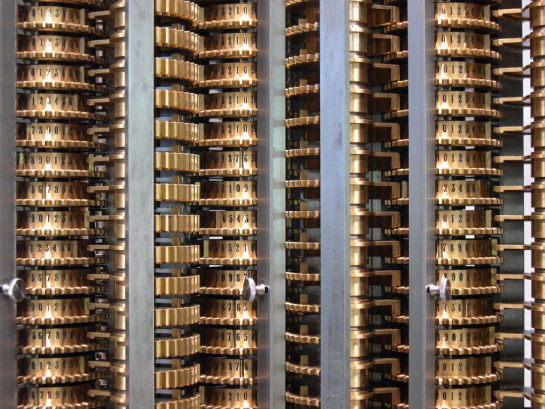
The mechanical age is when we first start to see connections between our current technology and its ancestors. The mechanical age can be defined as the time between 1450 and 1840. A lot of new technologies are developed in this era as there is a large explosion in interest with this area. Technologies like the slide rule (an analog computer used for multiplying and dividing) were invented. Blaise Pascal invented the Pascaline which was a very popular mechanical computer. Charles Babbage developed the difference engine which tabulated polynomial equations using the method of finite differences.
Difference Engine
Difference Engine
There were lots of different machines created during this era and while we have not yet gottent to a machine that can do more than one type of calculation in one, like our modern-day calculators, we are still learning about how all of our all-in-one machines started. Also, if you look at the size of the machines invented in this time compared to the power behind them it seems (to us) absolutely ridiculous to understand why anybody would want to use them, but to the people living in that time ALL of thse inventions were HUGE.

Electromechanical

Now we are finally getting close to some technologies that resemble our modern-day technology. The electromechanical age can be defined as the time between 1840 and 1940. These are the beginnings of telecommunication. The telegraph was created in the early 1800s. Morse code was created by Samuel Morse in 1835. The telephone (one of the most popular forms of communication ever) was created by Alexander Graham Bell in 1876. The first radio developed by Guglielmo Marconi in 1894. All of these were extremely crucial emerging technologies that led to big advances in the information technology field.
The first large-scale automatic digital computer in the United States was the Mark 1 created by Harvard University around 1940. This computer was 8ft high, 50ft long, 2ft wide, and weighed 5 tons - HUGE. It was programmed using punch cards. How does your PC match up to this hunk of metal? It was from huge machines like this that people began to look at downsizing all the parts to first make them usable by businesses andeventually in your own home.
Harvard Mark 1

Electronic

The electronic age is wha we currently live in. It can be defined as the time between 1940 and right now. The ENIAC was the first high-speed, digital computer capable of being reprogrammed to solve a full range of computing problems. This computer was designed to be used by the U.S. Army for artillery firing tables. This machine was even bigger than the Mark 1 taking up 680 square feet and weighing 30 tons - HUGE. It mainly used vacuum tubes to do its calculations.
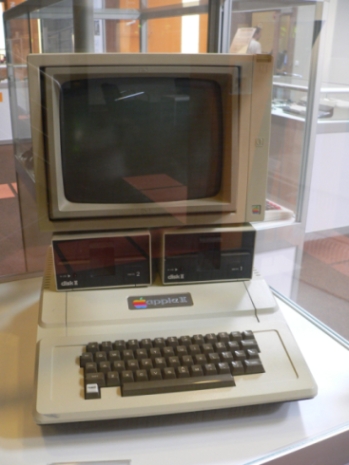
There are 4 main sections of digital computing. The first was the era of vacuum tubes and punch cards like the ENIAC and Mark 1. Rotating magnetic drums were used for internal storage. The second generation replaced vacuum tubes with transistors, punch cards were replaced with magnetic tape, and rotating magnetic drums were replaced by magnetic cores for internal storage. Also during this time high-level programming languages were created such as FORTRAN and COBOL. The third generation replaced transistors with integrated circuits, magnetic tape was used throughout all computers, and magnetic core turned into metal oxide semiconductors. An actual operating system showed up around this time along with the advanced programming language BASIC. The fourth and latest generation brought in CPUs (central processing units) which contained memory, logic, and control circuits all on a single chip. The personal comptuer was developed (Apple II). The graphical user interface (GUI) was developed.
Apple 2

http://openbookproject.net/courses/intro2ict/history/history.html

Media in Bhutan


Media in Bhutan is a fairly young development. The concept of the media, as a player in the growth of a modern society began in the mid 1980s, with the establishment of the first Bhutanese newspaper, Kuensel and the Bhutan Broadcasting Station. In the late 1990s, ICT was introduced followed by electronic and television. Today, Bhutanese media has grown considerably in all its forms – print, broadcast, film, music and internet.
Today, there are 11 newspapers (7 in English and 4 in Dzongkha) that includes Kuensel (1965), Bhutan Times (2006), Bhutan Observer (2006), Bhutan Today (2008), Business Bhutan (2009), The Journalist (2009), The Bhutanese (2012), Druk Neytshuel (2010), Druk Yoedzer (2011),Gyalchi Sarshog (2012), Druk Melong (2012) and five radio stations that includes BBS Radio (1973), Kuzoo FM (2006), Radio Valley (2007), Centennial Radio (2008) and Radio Waves (2010). While, the FM services and shortwave services of the BBS reach the entire country, Kuzoo FM radio services are available nationwide and remaining radio stations services are currently available only in Thimphu. Magazines range from news magazine such as Drukpa (2009), Voyager (2013) travel magazine to entertainment magazines that includes Yeewong (2008), Druk Trowa (2009), Student Digest (2011) and Bhutan Timeout (2012).
Television has only been introduced since 1999. Currently BBS TV is the only television channel that caters local news and programmes in Bhutan. The BBS launched its satellite television service in February 2006 and is now available in more than 40 Asian countries – from Turkey in the West to Indonesia in South East Asia. Cable television services are also available in Bhutan which covers almost all the parts of Bhutan provided by the cable TV operators. While the film industry is still in its infancy, the number of Bhutanese films has been increasing with more people venturing into the industry.
In recent years, social media has gained popularity with an increasing number of Bhutanese blogging, visiting popular social networking sites like facebook and twitter for news and information, interaction, and discussion among others.

Monday, October 21, 2013

game

instructional game is very important for the learner as they engage, motivate and inspire them whereby it enhance their learning. so as a future teacher we should not always lecture, sometime we need to give freedom for themselves to learn or explore.

Friday, October 18, 2013

reflection on instruction game

 I understood that teaching the children through game, making learning fun motivates students and helps them pay attention and stay focused on the subject. One reason to promote educatonal games is to encourage students to learn outside of class. Young adults will go out of their way to play games, even a single game, for hours on end. Young learners love to play, and they participate in a game with more enthusiasm and willingness than in any other classroom task. Yet, games are sometimes perceived as entertaining activities, playing which children are not really learning. There are teachers who fail to realise the importance of games, considering them not a wealth of various techniques and an opportunity for real communication but an uncontrolled and noisy waste of time. However, children in general learn better when they are active. Thus, when learning is channelled into an enjoyable game, they are very often willing to invest considerable time and effort in playing it. Moreover, in view of diverse learning styles and preferences the students display, benefits from games seem to cater for everyone as children find playing activities much richer language studying work than doing other kinds of practice. If games are properly designed, they may become an excellent and essential part of a children’s learning programme. so, as a teacher we should keep in mind that all the children does not learn through teaching sometime they learn through playing games.

Thursday, October 17, 2013

look before you leap.

Action will enable you to accomplish and achieve. But something must come before taking action: thinking.

Think first. Yes, think big and think bigger, but always think first.

Taking action without thinking will lead to many avoidable mistakes and errors. Taking action without thinking first will lead to unnecessary quarrels and arguments, hurt feelings, and misunderstandings.

Taking action without thinking will lead to wasting much time and energy.

Taking action without thinking might get you far, but it's likely to get you far in the wrong direction.

When you spend time thinking about your options and about consequences, you will be able to learn from each experience to think even better and wiser next time.

orgin and the meaning of friend in need is friend indeed

A friend in need is a friend indeed

Meaning

Almost always it is the origin of a phrase or saying that requires the most research; the meaning being well understood. This phrase is interesting because there are various interpretations of its meaning.
Firstly, is it 'a friend in need is a friend indeed' or 'a friend in need is a friend in deed'? Secondly, is it 'a friend (when you are) in need' or 'a friend (who is) in need'? If the former, then the phrase means: 'someone who helps you when you are in need is a true friend'. If the latter, it is 'someone who needs your help becomes especially friendly in order to obtain it'.
So, that gives us four options:
1. A friend, (when you are) in need, is indeed a true friend. ('indeed')
2. A friend, (when you are) in need, is someone who is prepared to act to show it ('in deed')
3. A friend, (who is) in need, is indeed a true friend. ('indeed')
4. A friend, (who is) in need, is someone who is prepared to act to show it ('in deed')
The original meaning can be resolved to some degree by the documentary evidence - see below. Nevertheless, there is no unambiguous right or wrong here and this is a phrase that we probably infer the meaning of from context when we first hear it. Whichever of the above options we initially opt for will cement our understanding of the phrase; probably forever, if the vehemence of the mutually contradictory mails I get on this subject are anything to go by.

Origin

A version of this proverb was known by the 3rd century BC. Quintus Ennius wrote: 'Amicu certus in re incerta cernitur'. This translates from the Latin as 'a sure friend is known when in difficulty'.
The Oxford Dictionary of Quotations lists it as existing in English from the 11th century. The earliest version I can find is from Caxton's Sonnes of Aymon, 1489:
"It is sayd, that at the nede the frende is knowen."
The morality play Everyman also contains similar lines. The play's date is uncertain and scholars place it as 'late 15th century', which could be before Caxton's work:
Fellowship: Sir, I say as I will do in deed.
Everyman: Then be you a good friend at need;
By the 16th century, when the proverb was recorded in John Heywood's A Dialogue Conteynyng Prouerbes and Epigrammes, 1562:
Prove [that is, test] thy friend ere [before] thou have need; but, in-deed
A friend is never known till a man have need.
Before I had need, my most present foes
Seemed my most friends; but thus the world goes
So, what does that evidence indicate in terms of original meaning? Ennius' text is ambiguous and, being a later translation, can't be considered the original source of the phrase in English. Caxton's version is also unhelpful. The Everyman play is clearer in its intent and supports interpretation 2. Heywood's verse can't be considered the original meaning as the other citations predate it. It is worth considering though as Heywood was an indefatigable recorder of proverbs as understood in England in the 16th century. It is safe to say that, whatever view we have now, in 1562 either 1 or 2 was the accepted meaning.
Neither 3 nor 4 appears to be supported by early texts and, as they aren't widely held today either, it seems safe to discount them. On the balance of evidence, interpretation 2 has the best claim to be the original meaning of the phrase, that is, 'a friend, when you are in need, is someone who is prepared to prove their friendship by their deeds' .
A search of web-based material shows that 'a friend in need is a friend indeed' has about twice the public currency as 'a friend in need is a friend in deed'. Those who stand up for the latter are probably correct, but they will have a hard time changing the mind of the 'indeed' contingent.

steps to be a good teacher.

Edited by Dan, Puddy, Glutted, DifuWu and 27 others
Being a good teacher can be the most rewarding and exciting job in the world - however, being a teacher who doesn't work effectively can be stressful, painful, and exhausting. Here are some great tips to being the best teacher you can be.


EditMethod 1 of 2: Classroom Management

  1. 1
    Set the example. Remember that you are the teacher. It is important for you to be like a "superhero" figure in their eyes. Remember that your students look up to you and will thus try to mimic your dispositions. If you are rude or inappropriate, they will have an inappropriate model for their behavior. It is vital that students see you as a person with confidence, so that they follow your lead, and feel comfortable trusting you. Students, of all ages, need someone they can lean on, look up to, and be able to trust.
  2. 2
    Have well-defined consequences. Set specific consequences for breaking the rules. Decide what those consequences are and then implement them consistently. Your consequences should follow a procedure that starts with a non-verbal signal (such as just looking at the student), to a verbal signal (asking the student to please stop talking), to a verbal warning (if this continues there will be consequences), to the implementation of the consequence. The consequences are up to you and depend on the program of the school. Many schools have a detention system (students do despise detentions), or perhaps writing lines, or sitting away from other students.
  3. 3
    Be compassionate. Great educators form strong relationships with their students and show that they care about them as people. They are warm, accessible, enthusiastic and caring. Be open to staying at school after-hours to help students or get involved in school-wide committees and activities, and they demonstrate a commitment to the school.
  4. 4
    Set some ground rules. You should have 3-5 rules that the students know about. These are the rules that, when broken, are subject to the consequence scheme outlined above. Try allowing the class to suggest the ground rules: have a class discussion and write ideas, it makes the class feel they are listened to and that you care about their opinions and input while also setting some groundwork that they will feel loyal to because they've made it. Act as a mediator to make sure that the rules decided upon are appropriate. Some may be, for instance, be quiet when the teacher is talking, respect each other, and finish the homework and classwork.

EditMethod 2 of 2: Lesson Planning

  1. 1
    Have an objective. When you are planning a lesson, the most vital part is the objective. What do you want your students to take away from the lesson? If the objective is powerful, deep, and reflects what you really want students to learn, it will be reflected in the lesson.
  2. 2
    Have a solid plan for your lessons. Each and every lesson should be divided into three simple parts that reflect your objective.
    • First should be the "lecture" part of the lesson. This is where you teach something new to the class (of course allowing for questions or comments when applicable).
    • Dedicate the second part of class to something that involves a collective group work element where students can work with whoever they want. Near the end of this part, you can have a discussion session where groups voice their findings/opinions, and give marks for adequate participation.
    • The final part of every lesson should be where the students return to their seats and work QUIETLY on one final task, such as answering specific questions written on the board, or drawing a picture related to something they learned that lesson. The students should only talk to you (if they have a question about what/how to do it) or the person sitting directly next to them. This is the wind-down part where students get a chance to work on and understand the material on their own.
  3. 3
    Assign relevant homework. Rather than assigning something different every night, it is wise to assign one or two more substantial assignments on Monday and then collect these assignments on Friday.
  4. 4
    Consider giving quizzes. You may want to have a quiz every Friday to assess how well the students are grasping the material. You can judge how well you are teaching by how well the majority of your students perform on the quizzes.

Being a good person is all God expects, right?

No doubt, it does matter to God that you be a good person. We certainly can't be on good terms with Him if we are evil.   
The Bible says God is "holy." That means He is so good and so just and so pure that He defines the words. No one can hold a candle to God when it comes to holiness.  
And God does tell His people -- many times -- to be holy because He is holy. If you want to be His child, there has to be a family resemblance.   
Problem is, none of us is holy. Not even close. The Bible says our best clothes are dirty rags compared to His dazzling white robe (Isaiah 64:6). All of us live our lives our way, not His (Romans 3:10-12). Living your life your way doesn't lead to eternal life. It leads to eternal death (Romans 6:23).  
Try as hard as you want to be a good person and earn eternal life, the truth is that you're human and you're going to make mistakes. In fact, you're not only going to make mistakes, you're actually going to choose to do the wrong thing on purpose.   
And choosing to do the wrong thing on purpose means you aren't good like God is good and you don't have any hope of earning eternal life.    That's the bad news. The good news is that God doesn't expect you to earn eternal life by being a good person!    God knew from the beginning that we would insist on doing things our way instead of His. That's why He sent His Son, Jesus. Jesus showed us how a truly good, sin-free human being would live. And when Jesus the only good man chose to let evil men kill Him, He made the sacrifice none of us could make for ourselves (1 John 4:9-10).   
The Bible says we don't have to be good to be saved from death. All you need to do is declare that Jesus is truly the Lord God and stake your life on the fact that God raised Him from the dead, proving that Jesus was who He said He was (Romans 10:9-10).   
When you do that, God gives you the gift you could never earn for yourself -- eternal life -- and He gives it to you for free! (Ephesians 2:8-9)    Don't deceive yourself with the idea that God's requirement for eternal life is being a good person. If that was true, we would all be doomed.    Instead, be honest. Admit you don't really have a chance of living a perfect, sinless life. Then let God give you the most wonderful gift anyone could ever hope to receive! 
by D. James Kinnaird
Happiness is the only medicine to cure grief. And our country as a exemplary to the world as a happiness. so be cool and always be happy with what you have.
Religion quotation


"Religion: A general term used... to designate all concepts concerning the belief in god(s) and goddess(es) as well as other spiritual beings or transcendental ultimate concerns."
~ Penguin Dictionary of Religions (1997).
*
"Religion: Relation of human beings to God or the gods or to whatever they consider sacred or, in some cases, merely supernatural."
~ Britannica Concise Encyclopedia (online, 2006)
*
"Religion: Human beings' relation to that which they regard as holy, sacred, spiritual, or divine."
~ Encyclopædia Britannica (online, 2006)
*
"Religion: (2) a personal set or institutionalized system of religious attitudes, beliefs, and practices; (4) a cause, principle, or system of beliefs held to with ardor and faith."
~ Merriam-Webster's Collegiate Dictionary (online, 2006)
*
"The religious response is a response to experience and is coloured by the wish to provide a wider context for a fragile, short and turbulent life."
~ Philip Rousseau, The Early Christian Centuries (2002), p. 4.
*
"Religion is the sigh of the oppressed creature, the heart of a heartless world, just as it is the spirit of a spiritless situation. It is the opiate of the people."
~ Karl Marx
*
"Religion is the human attitude towards a sacred order that includes within it all being—human or otherwise—i.e., belief in a cosmos, the meaning of which both includes and transcends man."
~ Peter Berger
*
"Viewed systematically, religion can be differentiated from other culturally constituted institutions by virtue only of its reference to superhuman beings."
~ Melford Spiro
*
"Religion is what the individual does with his own solitariness."
~ A.N. Whitehead
*
"...for limited purposes only, let me define religion as a set of symbolic forms and acts which relate man to the ultimate conditions of his existence."
~ R.N. Bellah
*
"Religion is the daughter of Hope and Fear, explaining to ignorance the nature of the Unknowable."
~ Ambrose Bierce
*
"A religion is a unified system of beliefs and practices relative to sacred things, that is to say, things set apart and forbidden—beliefs and practices which unite into one single moral community called a Church, all those who adhere to them."
~ Emile Durkheim
*
"One's religion is whatever he is most interested in."
~J.M. Barrie, The Twelve-Pound Look (1910)
*
"Religion consists in a set of things which the average man thinks he believes and wishes he was certain of."
~ Mark Twain
*
"Religion is an illusion and it derives its strength from the fact that it falls in with our instinctual desires."
~ Sigmund Freud, New Introductory Lectures on Psychoanalysis
*
"Religion is excellent stuff for keeping common people quiet."
~ Napoleon Bonaparte
*
"We go into religion in order to feel warmer in our hearts, more connected to others, more connected to something greater and to have a sense of peace."
~ Goldie Hawn, Beliefnet interview
*
"Religion is something left over from the infancy of our intelligence; it will fade away as we adopt reason and science as our guidelines."
~ Bertrand Russell
*
"Religions are the great fairy tales of conscience."
~ George Santayana
*
"Religion is all bunk."
~ Thomas Edison
*
"To be religious is to have one's attention fixed on God and on one's neighbour in relation to God."
~ C.S. Lewis, "Lilies that Fester" in The Twentieth Century (April 1955).
*
"Pure religion and undefiled before God the Father is this: To visit the fatherless and widows in their affliction, and to keep himself unspotted from the world."
~James 1:27, New Testament
*
"Religion is to do right. It is to love, it is to serve, it is to think, it is to be humble."
~ Ralph Waldo Emerson
*
"Religion itself is nothing else but Love to God and Man. He that lives in Love lives in God, says the Beloved Disciple: And to be sure a Man can live no where better."
~ William Penn
*
"Religion, whatever it is, is a man's total reaction upon life."
~ William James
*
"Belief consists in accepting the affirmations of the soul; Unbelief, in denying them."
~ Ralph Waldo Emerson